
Read This Before You Buy A Butcher Block Countertop
Updated: Oct 14, 2025
DIY butcher block look | budget-friendly laundry room makeover | plywood countertop tutorial

Let me save you some money.
Butcher block countertops are gorgeous — no question. But they’re also expensive, heavy, and only come in standard depths. For my laundry room, that just wasn’t going to work.
I needed a countertop wide enough to cover my oversized washer and dryer — something that looked intentional and custom but didn’t blow the budget. So instead of buying a pricey slab, I decided to build my own.
Here’s how I created a beautiful, custom “butcher block” look using plywood, a few simple tools, and some coffee-brown stain magic.
The Plan
Real butcher block was over $300 for the size I needed (ouch). My solution?
¾-inch maple plywood. It’s affordable, lightweight, and can be customized to any size or shape.
Pro tip: most hardware stores will cut it to your exact measurements — just triple-check those numbers before you go. 😉
For our space, I went with a 30-inch depth to fully cover our extra-large washer and dryer. That deeper counter made the whole laundry wall feel built-in and polished.
Step-by-Step: How to Build a Faux Butcher Block Countertop
Build the Base
If you’re using scraps (like I did), glue and clamp them together to make one big surface. If you’re starting with a fresh sheet, skip this step and enjoy your head start.
Cut It Down to Size
No need for a table saw. A circular saw + a clamped-on straight edge works perfectly. Take it slow and steady for clean lines.
Optional Cutouts
I notched out a small section for my vacuum, but you can skip that step if you don't need it.
Add Trim for the “Butcher Block” Illusion
Here’s my favorite trick: attach a 1x2 oak board along the front edge.
It does double duty — keeps the plywood from sagging and makes it look like a solid, thick butcher block slab (without the weight or price tag). Use your brad nailer for this one!
Sand Smooth
Use 220-grit sandpaper and go easy. You’re just smoothing, not stripping.
Over-sanding can cut through the top layer of plywood — ask me how I know.
Build Wall Supports
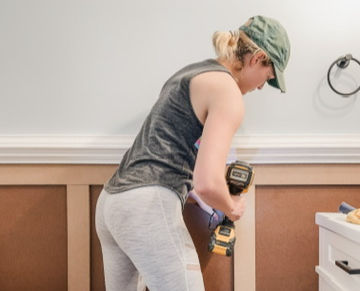
Install 2x2 cleats directly into your wall studs on all sides. These act like hidden ledges that hold up the counter.
Don’t forget the sides — your laser level is your BFF here.
Add Mid-Span Support
If your counter spans more than six feet, add a 2x4 brace in the middle for extra stability. Mine runs between the washer and dryer — totally hidden, totally solid.
Finishing Touches: Stain, Seal, and Shine
Don’t Skip the Wood Conditioner
If you’re using multiple types of wood (like plywood + oak trim), this step is crucial.
Brush on, wait 15 minutes, then wipe off the excess. It helps your stain go on evenly and prevents blotches.
Apply Your Stain
I used Minwax Coffee Brown Gel Stain — it’s rich, warm, and gives that “real wood” depth.
Let it dry at least 24 hours before moving on to your topcoat.
Topcoat Like a Pro
I finished with a water-based polyurethane (to avoid yellowing). It gives a smooth, wipeable finish that’s perfect for a laundry room where life definitely happens.
The Final Reveal
A fully custom, high-end-looking countertop for a fraction of the cost.
It’s lightweight, durable, and fits the space perfectly. And because I built it myself, I got exactly the look I wanted — no compromises, no budget regrets.
Quick Recap
Step | What I Used |
Countertop | 3/4 inch Maple Plywood |
Trim | 1x2 Red Oak Board |
Supports | 2x2 Wall Cleats + 2x4 Center Brace |
Stain | Minwax Coffee Brown Gel Stain |
Topcoat | Water-based Polyurethane |
Shop the Tools I Used
(I earn commission on some of these links at no extra cost to you)
DeWalt Circular Saw — my go-to for clean cuts without a table saw
Brad Nailer — makes trim attachment quick and satisfying
Wood Conditioner — helps prevent a splotchy application
Minwax Coffee Brown Gel Stain — rich color, easy to apply
Water-Based Polyurethane — no yellowing, fast-dry finish
Laser Level — a DIYer’s secret weapon for perfect alignment
Need More Visuals?
If you are looking for more visual aides, checkout the Instagram post for this project.


Comments